(FULL) “Deeper… Please, I Can’t Take It Anymore!” — The Rancher Froze… And Did The Unthinkable
(FULL) “Deeper… Please, I Can’t Take It Anymore!” — The Rancher Froze… And Did The Unthinkable
The wind had been screaming for two days. It was a high, thin sound that scoured the Wyoming plains bare and drove the snow into drifts taller than a man.
The world outside the cabin had shrunk to the four log walls and the gray howling white visible through the single smeared pane of glass.
Silus Ward sat at his rough huneed table, oiling a rifle trap mechanism. The metallic click and scrape was the only sound in the room that he made himself.
Everything else was the storm and the crackle of the fire. He was a man carved from the same hard land he lived on.
His isolation was a choice made 3 years ago when he buried his wife Sarah on the ridge behind the cabin.
The loneliness that followed was a sickness and the solitude was the only cure he knew.
He had come to this remote stretch of land to forget the world, and for 3 years the world had obliged him.
That was why the sound when it came felt like a betrayal. It was not the wind.
It was not the scrape of a nice heavy branch. It was a knock. A weak failing fist against the heavy oak door.
Silas froze. His hands stopped moving on the metal. No one came here. Not in summer, and certainly not in a blizzard that had buried the trails for a week.
A traveler would be dead miles before they reached his clearing. He waited. The wind howled, mocking him.
It came again, a desperate sliding sound, more a scratch than a knock. He rose slowly, the floorboards groaning under his weight.
He did not grab his rifle. Not yet, but his hand rested on the hunting knife sheathed at his belt.
He lifted the heavy iron latch and pulled the door inward. The wind tore the door from his hand, slamming it back against the wall.
A wall of white fury blasted into the room, scattering ash from the hearth and guttering the lamp.
And there, falling forward onto the floor, was a shape. It was not a person.
It was a bundle of frozen rags and snow. Small and dark against the threshold.
Silus stared, his face hard. He cursed a low, rough sound. He grabbed the door, fought the wind, and slammed it shut, plunging the room back into dim light.
The bundle on his floor did not move. He knelt. He pushed back a hood stiff with ice and saw a face.
It was young, blue with cold. The lips cracked and pale. Ice clung to the eyelashes.
It was a woman. “Damn,” he said again, not in pity, but in anger at the intrusion.
He stood for a moment, looking down at her. Part of him, the part that had survived the land wars and the loss of his brother, told him to leave her.
She was trouble. She was death. Walking in from the storm. But the other part, the part that remembered Sarah’s hand in his, could not.
With a grunt, he bent and hooked his arms under her. She weighed almost nothing.
He lifted her like a sack of feed and carried her to the fire, laying her on the worn, bare skin rug he kept there.
She was dirty. Her clothes were torn, and the smell of wet wool and something sour, like fear, filled the cabin.
He saw her hands. They were raw. The fingers curled. The tips of them a dark, waxy black, frostbite, bad.
He moved with a grim reluctance. He fetched the whiskey bottle from the shelf, unccorked it, and lifted her head.
He pressed the bottle to her frozen lips. “Drink,” he commanded. A little of the liquor spilled, but some went down.
She coughed, a dry, terrible rattle. Her eyes fluttered open, dark and vacant. “My name,” she whispered, her voice like sandpaper.
“I hush,” Silas said. “Don’t need a name.” He knew what he had to do.
He went to his chest and pulled out a fresh cloth and a bowl, filling it with warm water from the kettle.
He knelt by her again. He had to get the wet, frozen clothes off her.
It was a violation. He knew it, but it was that or let the cold finish her.
His hands were rough, pulling at the frozen laces of her boots, tearing at the stiff fabric of her dress.
He saw the bruises on her arms, dark purple against the pale skin. He saw the thinness of her.
This was not just a woman lost in a storm. This was a woman running.
He worked quickly, his face grim, avoiding her eyes, which were open now, watching him with a dull, terrified understanding.
He pulled the last of the wet rags away and threw his wife’s heavy quilt over her, covering her from chin to toe.
The quilt smelled of cedar and disuse. He looked away, his jaw tight. He walked to the other side of the cabin and sat on his cot, staring at the woman he had dragged into his world.
He felt the pull of the old scar on his side, a long pucker of flesh from a bullet meant to kill him during a land dispute that had ended with his brother dead in the mud.
He was scarred inside and out, and he wanted no more of it. The woman on the floor shivered, her teeth chattering.
Silas said nothing. He simply sat, a guardian and a jailer, and watched her breathe.
She woke to the smell of woodsm smoke and rabbit stew. For a moment, she was nowhere.
Then the terror returned. She was in a small, dark room, a log cabin. The walls were chinkedked with mud.
Furs hung from the rafters. A fire burned in a stone hearth. And a man was watching her.
He was sitting in a chair across the room, cleaning a rifle. He was large, broad in the shoulder, with a dark beard that needed trimming and eyes the color of a winter sky.
Scars marked his hands. Clara tried to sit up. A wave of dizziness and weakness crashed over her and she fell back onto the soft fur, gasping.
She was too weak to run. The man stopped his work. He looked at her, his expression unreadable.
You’re safe from the storm. He said, his voice was deep, grally from disuse. He did not say she was safe from him.
He got up and ladled some broth from the pot over the fire into a tin cup.
He walked over to her. He did not kneel, but crouched and held it out.
She stared at his hand. It was scarred, the knuckles split, the skin like leather.
She flinched, expecting a blow. His eyes narrowed. He did not move. Drink or die makes no matter to me.
Her stomach twisted, but she knew she needed strength. She reached out with a trembling hand.
Her fingers wrapped in clean bandages she did not remember. She took the cup. The hot tin burned, but the broth was life.
She drank it greedily, scalding her throat. When it was gone, he took the cup back.
“Who are you?” He asked. It was not a question. It was a demand. Panic seized her.
She could not tell him. She could not tell anyone. Anna, she lied. The name felt thick and wrong on her tongue.
Anna Smith, where you headed? Anna Smith. Cheyenne, she whispered. The lie building. I I was to meet my husband.
He’s working on the railroad. The man was silent. He looked at her left hand, which lay on the quilt.
It was bare. No husband, he said flatly. You ain’t got the mark of a ring and your hands ain’t seen a day’s work till this storm.
Clara’s blood ran cold. She tried again. I was I was working in Laram at a hotel.
Laram is south, the man said, standing up. You came from the east, South Dakota way.
The winds been blowing straight west for a week. You walked with it. Her eyes widened.
She had slipped up. She had been so cold, so lost. She had just followed the path of least resistance.
She said nothing. She pulled the quilt tighter, a wall against his questions. He grunted, seeming to lose interest.
He went back to his chair. Rest. You’re no good to me. Half dead. Clara lay back, her heart hammering.
She was trapped. She closed her eyes, and the heat of the fire mixed with the memory of another heat.
She was not in the cabin. She was in the vest, the air thick with the smell of old paper and beeswax.
Deacon Price was standing too close, his breath hot on her cheek, smelling of the whiskey he kept in his desk, his hand was on her arm, his fingers digging in.
“You are a preacher’s daughter, Clara,” he’d hissed. “But you have wickedness in your eyes.
I can see it. Let me help you pray it out.” He had not been praying.
The memory shifted violently. She was running. It was not the church, but the deacon’s fine house, his study.
He was on the floor. There was blood. So much blood. It was on her skirts.
A bright, terrible red against the gray wool. She was running, stumbling out of the house as his wife screamed, running into the twilight.
The first flakes of snow beginning to fall. Men were shouting her name. Stop her.
The harlot. She’s killed him,” she whimpered, jerking awake. The man in the chair was watching her.
He had not moved. His expression was still, but his eyes were sharp. He had heard her.
“There’s no one here but us,” he said, his voice low. “Stop your noise.” Silas kept his distance.
He was a man of strict, simple habits. And this woman had broken all of them.
He slept on his cot. She slept on the pallet by the fire. He gave her the quilt that had been his wife’s, a thing he had not touched in 3 years.
He fed her. He gave her blankets. But he said little. He would busy himself, checking his traps, splitting wood, reinforcing the small shed where he kept his one milk goat.
He would leave her alone for hours. At first, he would lock the door from the outside.
Then he found he did not need to. She had nowhere to go. The snow was a white prison.
When he returned, she would be exactly where he left her by the fire mending.
She had found his sewing kit. The woman, this Anna or Clara or whatever her name was.
Could so. She was mending his shirts, her stitches small and neat, her head bowed.
The domesticity of it angered him. It reminded him of Sarah. I don’t need you cleaning up,” he snapped one afternoon, tossing a skinned rabbit onto the table.
She looked up, her eyes wide and haunted. “I am repaying you for the food.
I don’t need repaying. I need you gone.” As soon as the snow melts, she whispered and went back to her sewing.
They lived in that silence. He watched her. He saw things he did not want to see.
He saw her grief. It was different from his. His was a hard, cold stone of rage.
Hers was a raw, trembling fear. She sensed his loneliness, too. He saw her looking at the empty chair at the table, the one he never sat in.
She saw the way he held his wife’s tin cup, his thumb rubbing the bent rim, and he noticed her tremble when touched.
One evening, he handed her a bowl of stew, their fingers brushed. She recoiled, pulling her hand back as if he had struck her.
The stew slopped onto the floor. She stared at the mess, her face pale. I’m sorry.
I I spilled it. Silus looked at her, then at the floor. He said nothing.
He took the bowl, refilled it, and set it on the floor beside her pallet.
He never tried to hand her anything again, neither asked questions. He did not ask what blood was on her skirts, though he had seen the dark rusty stains on the dress he had thrown into the corner.
She did not ask about the long puckered scar on his side, which he saw when he washed by the fire one morning.
They were two wounded animals trapped in the same den, wary of each other’s teeth.
The blizzard broke after 4 days. The wind died and the world was blinding white and silent.
Clara was stronger. The frostbite on her hands was healing, though her fingers were stiff and painful.
She began to move around the cabin, cleaning, tidying. It was a way to stay busy, a way to not think.
Silas watched her. She was repaying her debt. He needed wood. The wood pile by the door was buried.
He took his axe and went out, the snow crunching under his boots. The cold was sharp.
Clean. She followed him, wrapped in the heavy quilt. She stood on the porch, watching him swing the axe.
The thud and crack echoed in the stillness. “You’ll freeze,” he grunted, not looking at her.
“Show me,” she said. Her voice was quiet, but firm. He stopped mid swing. He looked at her.
“Show you what? How to chop? I can’t just sit.” He stared at her. She was soft.
A preacher’s daughter or a hotel maid. She was not made for this, but her eyes were steady.
Determined, he sighed. Fine, he taught her. He was a rough teacher. Hold it here, feet apart.
Swing. Don’t use your arms. Use your back. Let the axe do the work. Her first few swings were clumsy, glancing off the wood.
You’re not trying to kill it, he said. You’re trying to split it. Aim. She tried again and again.
Finally, a piece of wood split with a satisfying crack. A small triumphant smile touched her lips before she hid it.
He taught her other things. How to set a snare, how to bank the fire so it would last the night.
And he taught her how to milk Daisy, the goat. The goat was the only living thing Silas was gentle with.
He kept her in a small, warm shed, feeding her dried grasses he had cut in the summer.
Clara’s hands were hesitant. The goat bleeded, annoyed, and kicked the bucket. “You’re too soft on her,” Silas said.
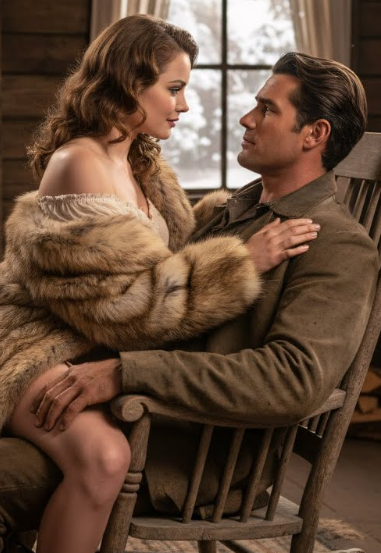
He moved behind Clara, his voice close to her ear. “Be firm like this.” He placed his large, scarred hand over hers, guiding her fingers to the teat, showing her the motion.
Clara went rigid. A terrible, shaking tremor started in her hands and moved up her arms.
She stopped breathing. Silas felt it. He pulled his hand back as if her skin were hot iron.
She turned her head away, her shoulders hunched. “I’m sorry,” she whispered. “I I can’t just milk the goat,” he said, his voice hard again.
He turned and left the shed, needing the cold air. He did not understand her, but he understood fear, and he knew deep in his gut that whatever she was running from, she had a right to run.
Over a week, the trust built. It was not a bridge of words. It was a bridge of shared chores, of silence, of survival.
The ninth night after she arrived, the nightmare came for her. Silas was asleep, a light, wary sleep.
He was dreaming of his brother, of the fight, the whiskey, the gunshot. He was woken by a scream.
It was not a yell. It was a sound of raw animal terror. He was out of his cot in an instant, rifle in his hand, scanning the dark cabin.
What? Who’s here? The fire was low, casting shadows that danced like devils. She was on her pallet, thrashing, fighting the blankets as if they were alive.
“No! Get off me!” She screamed, her voice tearing. “Please! No! Father! Help me!” Silas rushed to her side.
He was frozen. He did not know what to do. His instinct was to fight an intruder, not comfort a woman.
He was unsure whether to touch her. “Girl,” he said, his voice sharp. “Wake up!
You’re dreaming!” He put a heavy hand on her shoulder. She gasped, her eyes flying open.
They were wild, black with fear. She saw his dark shape looming over her in the firelight.
She did not see Silus. She saw a man coming to hurt her. She screamed again and launched herself at him.
It was not an attack. It was a desperate plea for safety. She clung to him, grabbing the rough wool of his undershirt, pulling him down.
She buried her face in his chest, her body shaking with sobs that had no sound, just a violent broken hitching.
Silas was stiff. His arms were wood. He had not held anyone since Sarah died.
This was wrong. It was an invasion of his space, of his grief. But she was shaking.
Shaking so hard he thought she might break. Please. She sobbed into his chest. Don’t let him.
Don’t let him. Slowly, awkwardly. His arms came up. He did not pat her back.
He did not soothe her with words. He just held her. His large, calloused hands rested on her back.
His body a solid, warm wall against the dark. He held her protectively, shielding her from the ghosts in the room.
He sat on the cold floor, his back against the cot, and held the trembling woman in his arms.
He held her until the terrible shaking quieted, until her gasps slowed, and until she was just a dead weight, asleep from exhaustion against his heart.
He did not move. He sat in the dark and listened to the fire crackle, a stranger in his arms, and felt the loneliest he had felt in 3 years.
In the morning, he was already up when she stirred. He was stoking the fire, his back to her.
He had not slept. He had moved her back to her pallet hours ago, covering her with the quilt.
She sat up, her hair a wild tangle. The shame was thick in the air, coating her tongue.
She remembered. She remembered clinging to him. “I Her voice was rough. I apologize for the night.”
Silus did not turn. He kept poking the fire. No need. He poured coffee from the pot into two tin cups.
He walked over and handed one to her. This time he did not set it on the floor.
He handed it to her. Their fingers did not touch, but they were close. “Thank you,” she whispered.
“It was for the coffee. It was for the night. It was for not leaving her on the porch.”
He nodded, taking his own cup. He sat in his chair. She sat on her pallet.
They shared the coffee by the fire, watching the new day’s light fill the cabin.
Outside, a light snow had begun to fall again, soft and gentle. They watched it in silence.
It was not the empty silence of before. It was a shared quiet. The storm inside the cabin had broken, and neither of them knew what came after the storm.
The blizzard had broken, but the storm lingered. It settled into a grim gray siege, depositing a heavy, wet snow that added weight to the world and worry to Silas’s mind.
The wind had been a fury, and it had found weaknesses. A section of the roof near the chimney had been savaged.
The cedar shingles torn loose. Silas would have to fix it, or the melt would rot him out.
He worked in the biting cold, hammering his teeth, balancing on the slick, snowdusted incline.
Clara stood below on the porch, handing him what he needed. First the pry bar, then the fresh shingles he’d kept stacked in the shed, then the hammer, and finally the nails he held in a small tin.
Their hands met with each exchange, his bare and scarred, red from the cold. Hers still healing, the skin of her fingers tight and pink where the frostbite had been.
Neither spoke more than was necessary. Nails here, shingle here. But the silence was different.
It was no longer the hollow, empty, quiet of his isolation, nor the weary animal quiet of her first few days.
It was a shared space. It was the quiet of two people working on the same task.
He found himself watching her. He watched the way she held the hammer. Ready, her eyes on him, waiting for his next move.
He watched the way the wind pulled strands of her dark hair from the loose braid she’d made.
She was still too thin, the quilt she wrapped around her shoulders, swallowing her whole, but she was not the half-dead creature he had dragged inside.
There was a strength in her stance. She, in turn, watched him. She saw the raw, brute power in his shoulders as he ripped the old wood free.
She saw the focus in his face, the way he set his jaw against the cold.
He moved with a purpose that was comforting. He was a man who knew how to fix what was broken.
Their glances lingered longer than they should have. When his eyes met hers, she no longer looked away in terror.
She held his gaze for a moment, a flicker of acknowledgement before looking down at the tin of nails.
Her body was healing, but her mind was still a raw wound. The cabin was small and their lives were lived in each other’s pockets.
Silas had habits she learned quickly. He had a few books on a high shelf stacked next to a worn leatherbound Bible.
Clara in her quest to repay her keep. Dusted every surface in the small cabin.
She dusted the table, the chairs, the lamp, the cot. She even dusted the lower shelves, but she never touched the high shelf.
She would reach up, her rag in hand, and stop, her arm frozen, as if the book itself were hot iron.
One morning, Silas sat at the table, a plate of fried salt pork and heart attack before him, out of a habit he thought he had long since broken, a habit from his life with Sarah.
He bowed his head for a moment, a silent, grim acknowledgement. He did not pray.
Not really. He just paused. When he looked up, Clara was pressed against the far wall, her hand to her mouth, her eyes wide with a familiar, haunted look.
He scowlled. “What is it?” “Nothing,” she whispered, her voice trembling. “You were praying.” “I was sitting,” he said gruffly.
“A man can sit before he eats. It’s just I” She looked at the Bible on the shelf.
I don’t hold with prayers or men who say them. The bitterness in her voice was sharp enough to cut.
Silas said nothing. He had seen the blood on her clothes. He knew she was running from something.
Now he knew it had something to do with a church. He filed the knowledge away and began to eat.
Silas had his own ghosts. They visited him when he was alone, which was harder to be.
Now he took the milk bucket and went to the shed, kneading the smell of the goat and the hay in the cold.
He leaned against the rough wood wall, his bad leg aching, the old scar on his side pulling tight.
He thought of his brother, Levi. The outline of the memory was always the same.
A saloon in Laram, smelling of sour whiskey and wet wool. He and Levi paid off from a cattle drive, flushed with coin.
They had been drinking for 2 days. An argument not over a woman or cards, over something stupid, over nothing.
Silas had been a mean drunk then, full of a directionless rage. Levi had pushed him.
He had pushed back harder. Levi stumbled, his boot catching on the leg of a chair.
He fell backward. The sound of his head hitting the polished brass foot rail of the bar was not loud, but it was final.
Silas had knelt in the sawdust, shaking his brother, telling him to get up. Long after everyone in the saloon knew he would nod.
The rage did not leave him. It turned inward, burning him hollow. He met Sarah a year later.
She was quiet like this one. She thought she could save him. Maybe she could have.
But then came the baby, the stillborn child, a small, perfect, silent boy. He remembered the midwife’s panicked eyes.
He remembered Sarah, pale against the sweat soaked sheets, her hand slipping from his, her voice a thin whisper.
It’s all right, Silus. But it was not all right. He had been left alone with the rage and the memory of two people he had failed.
He had come to these planes to let the silence and the snow bury him.
Two, he kicked the wall of the shed, a sudden violent act. Daisy bleeded in alarm.
He cursed, grabbed the bucket, and milked the goat with rough, angry hands. When he returned to the cabin, Clara was by the fire, mending his shirt.
She looked up, sensing the darkness that had followed him in from the shed. She said nothing, but her hand stopped moving.
That night, the silence stretched, thicker than usual. The fire crackled. The wind was picking up again.
Clara sat on her pallet, her needle poised over a tear in his wool trousers.
“Why are you here?” She asked, her voice so quiet he almost did not hear it.
He stopped cleaning his rifle, his hands still. “What? Here, this cabin. It’s so far.
There’s nothing for miles, no town, no people. Why do you live alone?” Silas put the cleaning rod down.
He looked at the fire. He did not want to answer. He did not want to give words to the things that kept him pinned to this piece of land.
“It’s quiet,” he said. She shook her head, her eyes on her mending. “It’s more than quiet.
It’s empty. You’re You’re not a man built to be empty.” “Mister Ward.” Her words hit him.
A physical blow. He stared at her, this wisp of a thing he had pulled from the snow.
Seeing him, seeing the cracks in the wall he had built around himself, he opened his mouth.
The words were rust. I built this place for for my wife. His voice broke on the last word.
It was a dry, cracking sound, like old leather splitting. He had not said the word wife aloud in 3 years.
He cleared his throat, angry at the weakness. He looked away from Clara, at the empty chair across from him.
Sarah, her name was Sarah. She She’s buried on the ridge, behind the trees, the cabin, the land.
It’s all that’s left. He did not speak of Levi. He did not speak of the stillborn child, but he had given her the heart of it.
The cabin was deathly quiet. Clara had stopped sewing. He had shown her his wound, and he waited, his shoulders braced, for her to either turn away or offer the kind of useless pity he despised.
She did neither. She waited, letting his words settle in the space between them. Then she gave him a piece of her own.
“You asked my name when I first woke,” she said, her voice a low murmur.
I lied. “It’s not Anna.” Silas turned his head. He looked at her. Her face was pale in the fire light.
Her eyes deep and dark. My name is Clara. Clara Jennings. She took a shaky breath.
My father. He is a preacher in South Dakota in a town called Redemption. She gave a small bitter laugh at the name.
I shamed him. I shamed his church. I did something that could not be forgiven.
I had to leave. She did not say what she did. She did not speak of the deacon or the blood, but she had matched his confession.
She had given him her name and her shame. Silas picked up his rifle, his movement slow.
A name is a name. Clara, preacher’s daughter or not, the snow treats everyone the same.
It was absolution. It was acceptance. It was the only kind he had to give.
In that quiet, Clara began to find a strange comfort. Silas was not a kind man.
He did not offer soft words. He did not smile. When she was clumsy, he was gruff.
When she burned the cornbread, he scraped the black off and ate it without comment.
But his silence was a judgment. But he was never cruel. He never raised his voice.
Say for that first day. He never raised his hand. When he saw her shivering by the fire, he would get up wordless and toss another log on.
When he skinned a rabbit, he always gave her the better portion of the stew.
He had taught her to split wood, and now he just left the axe by the pile, trusting her to do her share.
This, she realized, was his version of care. It was not the false sweet comfort of the deacon, whose hands were soft and whose words were poison.
It was a steadiness. It was a reliability. Silus Ward was a hard man, but he was a safe one.
He was a wall against the wind, and he had not buckled. The storm that had been threatening all day finally hit 2 weeks after she had arrived.
It was not a blizzard. It was a storm of ice and driving sleet that rattled the windows and found every crack in the cabin.
A leak started, a steady drip, drip, drip, near the hearth. The patch on the roof had not held.
Silas cursed, his voice low and furious. He looked at the ceiling where a dark stain was spreading.
It’ll rot the main beam. I have to fix it now. In this? Clara asked, looking at the gray, swirling ice outside.
You’ll be killed. I’ll be homeless if I don’t. He snapped. He pulled on his heavy coat, grabbed his hammer and a handful of nails.
Hold the lantern. Stand on the porch. Give me light. He went out into the roaring dark.
Clara followed, pulling the heavy door shut against the wind. The sleet stung her face, instantly cold and wet.
She held the lantern high, its yellow light pathetic against the massive, stormy dark. She watched his dark shape climb onto the porch rail, then heave himself up onto the slick roof.
He moved carefully, a shadow against the gray sky. “Be careful,” she yelled over the wind.
He didn’t answer. She heard the bang, bang, bang of the hammer. He was working fast, trying to nail a loose piece of flashing back down.
Then she heard a different sound, a scrape, a curse. Swallowed by the wind, he slipped.
She saw his shape slide down the icy roof. He tried to catch himself, but there was nothing to grab.
He hit the edge of the porch overhang with a heavy, sickening thud and then fell, crashing into the deep, hard-packed snowdrift below.
“Silus!” She screamed. The name was torn from her throat. She dropped the lantern. It sputtered and died in the snow and plunged into the drift, fighting her way to where he had fallen.
He was groaning, a low, pained sound. He was on his back, trying to push himself up.
Silas, are you hurt? My leg? He gritted, his voice tight with pain. Damn it, my leg.
She grabbed his arm. We have to get you inside. It was a nightmare. He was a heavy man and his left leg was useless.
He leaned on her, his arm draped over her shoulder, his entire weight pressing her down.
She staggered under the load, her feet slipping in the snow, the ice stinging her face.
He smelled of wet wool, pine, and pain. She half dragged, half carried him onto the porch and through the door, slamming it shut.
He collapsed onto his cot, his face pale and slick with sweat and sleet. My boot, he gasped.
Get it off, she knelt, her hands shaking, and tried to pull at the heavy wet leather.
He cried out a sharp choked sound. Stop. Can’t the knife on my belt. She saw it.
She pulled the heavy hunting knife from its sheath. What? Cut the pant leg up the side.
I can’t feel my foot. Her heart hammered. She took the knife, the blade cold and sharp.
She pressed it to the thick wet denim of his trousers and sliced, cutting the fabric from his ankle all the way up his thigh.
She pulled the torn fabric apart. The wound was long and deep. A ragged gash on the outside of his thigh starting just above the knee.
A piece of metal flashing perhaps, or a roofing nail. It was bleeding badly. A dark pulsing stain spreading onto the blankets.
Water, he said, his eyes closed. Whiskey and rags. Clean ones. She flew. She did not think.
She stoked the fire, put the kettle on. She tore one of his old clean shirts into strips.
She grabbed the whiskey bottle. She came back and knelt beside the cot. “This will hurt,” she whispered.
“Just do it,” she poured the whiskey straight into the wound. Silas did not cry out, but his whole body went rigid.
A low hiss escaped his teeth. Clara took a breath and began to clean the wound.
She had to touch him. Her fingers still tender from the cold, pressed against his skin, wiping away the blood and grime.
She saw his leg. It was hard, muscled, covered in dark hair. She saw the old puckered scar on his side, disappearing into the trousers she had not cut.
She saw the naked, vulnerable flesh of his thigh. Her hands trembled, but not from fear.
A strange, confusing warmth spread through her belly. It was the most intimate contact she had ever had with a man that was not violent.
He was hurt. He was letting her help. He was trusting her. He was watching her.
His eyes were open, narrowed in pain, but he was watching her face. He watched her careful, focused movements.
He watched the way she bit her lip, her expression a mixture of pity and determination.
She finished cleaning it. The bleeding was slowing. “It needs stitches,” she said, her voice shaky.
“I I don’t know how.” “It’ll hold,” he said, his voice rough. Bind it tight.
She took the strips of cloth and wrapped his thigh, pulling the edges of the wound together.
Her hands moved over his skin, around his leg, pulling the bandage tight. When she was done, her hand rested on his leg just above the bandage.
For a second too long, she felt the heat of him, the solid strength. She pulled her hand back as if burned, her face flushing.
You did good, he said and closed his eyes. He was laid up for 3 days.
The leg was bad but not broken. He was trapped on the cot and his temper was foul.
Clara was now the master of the cabin. She did everything. She milked Daisy. She chopped the wood.
Her swings becoming more confident. She cooked. She brought him his food. The woods not split fine enough.
He grumbled, watching her try to feed the fire. The stew is thin. You let the fire get too low.
On the third evening, she finally snapped. She slammed his tin plate of beans onto the small crate beside his cot.
“Then you get up and do it yourself,” she said, her voice sharp. Silas looked up at her, surprised.
A flicker of something, not quite a smile, but a softening touched his eyes. “Maybe I will,” he said.
“Later.” She sat on the bare skin rug by the fire, exhausted. Her back achd.
Her hands were sore. Without thinking, she leaned back, resting her head against the wooden frame of his cot.
Her shoulder brushed against his good leg. Neither of them moved. He did not pull away.
She did not apologize. It was a new kind of silence. Comfortable. The nightmares came back that night.
Not the screaming ones. They were the other kind. The ones that suffocated her. She dreamed of the deacon study, of the smell of his whiskey, of his hand on her, of the letter opener in her own.
She woke with a silent gasp, her body drenched in a cold sweat. She was shaking.
The fire was just embers, casting a low, red glow. The cabin was cold and dark.
She could hear the sound of silus breathing, a low, steady rumble from the cot.
She was so cold, but it was not the room. It was the fear. It was the loneliness.
It was a cold that came from inside her bones. A cold that only another human body could warm.
She sat up, pulling the quilt around her. She looked at the dark shape of the man on the cot.
He was her protector. He was steady. He was safe. “Silus,” she whispered into the dark.
The breathing stopped, a moment of silence, then a low grunt. “What? I I’m cold.”
She heard him shift, the cot groaning. Fires spanked. Put another log on. It’s not that.
She swallowed. Her voice was a small trembling thing. It took every piece of courage she had left.
It’s It’s the dreams. She waited. “Will you will you hold me while I sleep?
Just hold me.” The silence that followed was absolute. It was so long. She thought he had fallen back asleep or was ignoring her.
She felt a hot rush of shame. When he finally spoke, his voice was rougher than she had ever heard it.
“Get in,” she froze. He couldn’t mean it. “I’m not getting up,” he said, his voice tight with pain and something else.
“Get in.” She rose from her pallet. A ghost in the dim red light. She walked to the cot.
It was narrow, barely wide enough for one man. He moved his injured leg, grunting as he shifted his body closer to the wall.
He left a small, grudging space for her. She lay down on top of the blankets, still wrapped in her own quilt.
She lay on her side, stiff as a board, her back to him. She was terrified.
She had asked for this, and now she was terrified. She felt him hesitate. He was a dark, warm presence behind her.
Then slowly, as if it weighed 1,000 lb, his arm came over her. He draped it across her waist, his hand resting on her side.
They lay there, not touching anywhere else. His chest was not touching her back. His legs were not touching hers, just the heavy solid weight of his arm.
It was not sexual. It was not comfort, not really. It was an anchor. It was a guard.
Silas stared at the log ceiling, visible in the faint light. He was acutely, painfully aware of her.
He could feel the warmth of her body, even through the two quilts. He could smell the faint, clean scent of her hair mixed with wood smoke.
He felt her take a long, shaky breath, and then another, slower one. She moved her hand.
He felt her small bandaged fingers find his forearm, the one that lay across her stomach.
She did not grab him. She simply rested her hand on top of his. Her hand was resting over his heart.
He did not sleep. He lay awake in the dark, a living, breathing woman in his arms.
He felt the slow, steady beat of his own heart under her hand, and felt the ice that had gripped him for 3 years begin to crack.
The world began to melt. The shift was not gentle. It came with the sound of cracking ice and the steady maddening drip drip drip of water from the eaves.
The white prison that had held them captive for weeks turned to gray slush and brown.
Grasping mud, the creek behind the cabin, long silent under a sheet of ice, found its voice again.
A low, rushing roar. Silus’s leg was healing. The gash had closed, leaving a new jagged scar that joined the others.
He still favored it, a slight limp he fought to hide, but he was mobile.
The confinement had made him restless, his energy a low, thrumming anger. Now he was outside from sun up to sun down, and Clara was beside him.
She was no longer a guest, nor a patient. She was a partner of a sort.
She had taken over the milking of the goat, her hands now firm and sure.
She had learned to read the sky, to bank the fire, to portion the dwindling supplies of flour and salt.
Now she learned the woods. He took her with him to check his trap lines.
He moved with a quiet grounding stride, and she had to work to keep up, her boots, which he had patched with deerhide, sucking at the mud.
“Look,” he said, stopping. He pointed not at his trap, but at the mud near the creek bed.
She squinted, seeing nothing but a mess. What? Tracks, dough, and a fawn went by this morning.
See how the edges are sharp? Before the sun hit, he showed her the difference between a deer’s print and a wolf’s.
He showed her how to find the snares he’d set, marked by a broken twig or an unnatural bend in a sapling.
She was a quick study. She was quiet, and she watched. When he reset a snare, his large, scarred hands moving with an unexpected delicacy.
She committed the intricate knot to memory. The next day she set one herself. It was clumsy, but it held.
They hauled water together, the heavy yolk balanced between them. They cut wood. The thud of his ax punctuated by the crack of her splitting the smaller rounds.
One afternoon, Silas was trying to clear a deep drift of old, heavy snow that had half buried the shed.
He was leaning heavily on his shovel, his bad leg stiffening in the wet cold.
He slipped, the shovel flying from his hands as he landed hard in the mud, cursing, his face a mask of frustration and pain.
He looked up, expecting her to be standing there, silent and watchful. Instead, Clara laughed.
It was not a titter. It was a full, sudden, clear laugh that startled the birds from a nearby pine.
It was the first human sound in his world, other than his own gruff voice.
That was not born of pain or fear. Silas stared at her. He had never heard her make such a sound.
Her face, usually so pale and solemn, was lit from within. He felt the corners of his own mouth twitch.
A strange, unfamiliar warmth spread across his chest. He shook his head, a grunt that was almost a chuckle, and reached out a muddy hand.
“Well, don’t just stand there. Haul me up.” She took his hand, still smiling, and pulled.
Their shared smile was more intimate than any touch had been. After that, things were easier.
She began to braid her hair again, her fingers weaving the dark strands into a neat plat that hung down her back.
It was a small act of self-possession, a sign that the woman she had been was returning.
Silas watched her when she was not looking. He watched her by the fire, her head bowed over a piece of mending, the light catching the red in her hair.
He watched her outside, her cheeks whipped pink by the wind, her body growing stronger from the work.
He had taken her in as a burden, a package of rags and bones. He was beginning to see her as Clara.
The new awareness was a problem. It was an ache. It was a tightness in his chest he had not felt since Sarah.
He tried to push it down to turn it back into the familiar cold rage he knew how to manage, but it would not go.
One morning he rose before dawn to check a long trap line miles up the ridge.
He left her sleeping. A dark shape under the quilt. The air was cold, but the smell of pine and thawing earth was in it.
He felt the pull of spring, a restless energy. He was gone most of the day.
His hall was good. Two rabbits and a small beaver. He returned in the late afternoon, tired, hungry, and smelling of mud and blood.
He pushed open the cabin door without thinking. “I need,” he started to say. He stopped.
The big tin bath, usually hung on a nail by the door, was on the floor in front of the fire.
Steam rose from it, filling the cabin with a sharp, clean scent of lie soap.
Clara was in the bath. She had been rising, perhaps to get a towel. Her back was to him.
He saw everything in one searing instant. The pale line of her spine, the curve of her hip, the dark, wet tangle of her hair piled on her head.
He saw the last faded yellow of the bruises on her ribs. He saw the startling vulnerable whiteness of her skin against the cabin’s gloom.
He stumbled back, crashing into the door frame. A jolt of pure hot shock went through him.
I I He turned, his face burning. Sorry, I apologize. I didn’t see. He fled.
He bolted from the cabin like it was on fire, pulling the door shut behind him.
He stood on the porch, his heart hammering, his breath coming short. He dropped the rabbits on the bench.
He saw her naked body burned into his mind. He felt a deep, profound shame at his intrusion.
And under it, a sharp, undeniable bolt of desire that made him feel even more ashamed.
He grabbed the axe from the splitting block, needing to break something. He attacked a large, naughty piece of pine, swinging with a violence that had nothing to do with the wood.
A few minutes later, the cabin door opened. He heard it creek, but he did not stop.
He kept swinging. Thud, crack, thud, crack. Silus. Her voice was quiet, but it cut through the sound of the axe.
He stopped, his arms shaking, the ax blade buried deep in the wood. He would not, could not look at her.
He kept his back to her, staring at the ruin of the log. You don’t have to apologize.
She said, “A man don’t walk in on a woman.” He growled, yanking the ax free.
I left the bar on the door. I I thought you’d be gone till dark.
It was my fault. He said nothing. He could feel her standing there just behind him.
He could smell the soap on her skin. She took a step closer. She was wrapped in the quilt, her feet bare in the mud of the porch.
Her hair was damp, hanging in dark waves. “Look at me,” she said. He turned slow and reluctant.
His face was hard. His eyes guarded. She looked small, wrapped in the heavy wool, but her gaze was steady.
She was trembling, but not from the cold. “When you saw me,” she began, her voice a whisper.
“You ran, Deacon. The men in redemption, they would not have run. She looked down at her bare feet.
The way they looked at me, it made me feel dirty, like I was spoiled, tainted.
She looked up at him, and her eyes were filled with a terrible, aching vulnerability.
Am I ugly to you, Silus? Is that why you ran? Am I ruined? The question hung in the cold air, a fragile, breaking thing.
He stared at her, the axe heavy in his hand. He saw her, not just the woman in the bath, but the terrified girl on his floor, the phantom in his bed, the determined partner at his side.
He saw all the pain she had carried into his cabin. He struggled for words.
His throat was thick. He dropped the axe. It clattered on the stones. “Ugly,” he said.
His voice was raw, “broken.” He took a step toward her. He shook his head, a small violent motion.
No, you’re not ugly. He reached out, his hand stopping an inch from her face.
You’re You’re the first thing I’ve looked at in 3 years, and not wanted to forget.
The chasm between them was crossed. He had not touched her, but he had held her.
She closed her eyes, a single tear tracing a path down her cheek. She did not wipe it away.
That night, the tension was a living thing in the cabin. They ate the rabbit stew he had cooked, the silence vibrating, every brush of his hand as he passed her the spoon.
Every time their eyes met, was a fresh shock. After they sat by the fire, she on her pallet, he and his chair.
The space between them felt vast. Silas got up. He put another log on the fire, sending a shower of sparks up the chimney.
He did not go back to his chair. He turned and looked down at her.
He knelt on the bare skin rug. He was close but not touching. He could see the pulse in her throat, fluttering like a trapped bird.
“CL,” he said. “Just her name.” She looked at him. He moved slowly, giving her every chance to pull away.
He raised his scarred hand and touched her face. His thumb, rough as bark, brushed the line of her jaw.
She did not flinch. She did not recoil. She leaned into his hand, her eyes closing.
He leaned in. Their first kiss was not a kiss. It was a question. His lips dry and chapped, barely brushed hers.
He tasted the salt of her tears from that afternoon. He tasted the faintness of the rabbit’s stew.
He tasted her. She let out a small, shuddering breath and kissed him back. Her hand came up, not to his chest, but to his wrist.
Holding his hand against her face, the kiss was slow, tentative, a discovery. It was soft, then harder.
He felt a deep, buried thing inside him. A cold, hard knot of grief and rage begin to unwind.
He felt her tremble. It started in her hand and moved through her whole body.
It was not the shaking of cold. It was desire, sharp and sudden, and it was fear.
She gasped, pulling back, her eyes flying open. They were wide, dark, and terrified. “I’m sorry,” she whispered, her voice choked.
“I I can’t. Please, I’m not ready.” She scrambled back, pulling her knees to her chest, her face pale.
The ghosts were back. The ones from her nightmares. Silas froze. The ache inside him was sharp.
A physical pain. He wanted to tell her it was all right. He wanted to reach for her.
He did neither. He looked at her, huddled and afraid, and the desire vanished, replaced by a deep, weary understanding.
He had seen that fear before. He nodded once, a short, sharp motion. He stood up, towering over her.
For a second, she thought he would be angry. Instead, he turned his back on her.
He went to his cot, took his blanket, and walked to the door. “Silus, wait,” she said, her voice small.
“You need space,” he said, not looking back. “I’ll sleep in the shed. The goat won’t mind.”
He left, closing the door softly behind him, leaving her alone with the fire. His respect was a physical thing, more powerful than any embrace.
The next day, she found him carving a piece of pine. He was making a new handle for the axe.
The silence was brittle. He had been kind and she had rejected him. She had to make him understand.
Silus. He stopped carving, his knife pausing on the wood. He did not look up.
Ma’am, he was being formal. The wall was back up. I have to tell you, she said, her hands twisted in her apron.
You have to know why I why I was scared. He kept his eyes on the wood.
You don’t have to. Yes, she said, her voice gaining strength. I do. You deserve to know.
She told him everything. She told him about Deacon Price, a man with a soft, damp handshake and eyes that lingered too long, a man who was her father’s closest friend, a pillar of the church in redemption.
She told him how the deacon had offered her private spiritual guidance, how he had trapped her in the church vestry, his breath smelling of the whiskey he kept in his Bible.
She did not use the ugly words, but her meaning was clear. “He he forced me,” she whispered.
The shame a hot brand. “He said he said I was a wicked, tempting girl, and this was God’s way of purging my sin.”
Silas’s knife stopped. He was still She told him how afterward the deacon had been terrified she would tell.
How he had gone to her father first. How he had spun a tale of a lonely, hysterical girl who had thrown herself at him, begging him to run away with her.
And my father, my father believed him. The words were acid. He called me a harlot, a Jezebel.
He said I’d brought ruin to his house. He disowned me. He told me to be gone before my wickedness infected the whole town.
She was crying now, silent, angry tears. I had nowhere to go. I I ran.
I just ran. Silus sat in silence for a full minute. The only sound was the drip of water from the shed roof.
His face was granite. His knuckles gripping the knife in the wood were white. He was filled with a cold, pure rage that was almost black.
He was not angry at her. He was angry at a world that could do this.
He looked up. His eyes were the color of a winter sky, hard and clear.
He did not look at her with pity. He looked at her with a terrible validating quiet.
What he did, Silas said, his voice flat, each word a stone. You didn’t deserve it.
He looked back at the wood, his thumb rubbing the grain. What they did. Your father, that deacon.
He spat the word. They’re the ones who answer for it, not you. It was the first time anyone had believed her.
It was the first time anyone had taken her side. She sagged against the doorframe, the weight of her shame finally lifting.
That night, she did not go to her pallet. He was on his cut, his back to the room.
She walked over quiet. He heard her. He felt her presence. He moved. Shifting his body, making space.
She did not lie on top of the blankets. She lifted them and slipped in beside him.
She was fully clothed, still wearing her wool dress. She lay on her side, her back to him.
She waited. She felt the cot shift as he turned. His arm came around her waist, pulling her back against his chest.
His body was a solid wall of heat. He buried his face in her hair, breathing her in.
They lay entwined. Two clothed, broken people holding each other against the dark. There was no lust in it.
It was something more. It was a promise. It was peace. They slept this way for a week.
The routine was set. They worked. They ate. They slept. Wrapped in each other’s arms.
They did not kiss again. The intimacy was in the shared work, the quiet understanding, the nightly embrace.
But the need was building. It was not the sharp, fearful desire of before. It was a deep, slow, aching pull.
It was the need to close the last small distance between them. One night, a spring storm raged outside, the rain lashing the roof, the fire was low.
They were in the cot, tangled together, his hand resting on her stomach, her head tucked under his chin.
He thought she was asleep. She turned in his arms, her movement small until she was facing him in the near total dark.
She could only see the shadow of his face. “Silus,” she whispered. “I’m here,” she was trembling, a deep internal shaking.
“I’m still scared,” she said, her voice raw. “I’m I’m so scared, but I’m more scared of of being empty, of being alone in my own skin forever.
She pressed her face into his chest, her hands gripping his shirt. Her voice was muffled.
A desperate, breaking plea. Deeper. Please, I can’t take it anymore. Silas went rigid. He froze.
He understood. This was not the plea of a woman for a man’s body. This was the plea of a soul asking to be seen.
She was not asking for release. She was asking for connection. She was asking for all of him.
To meet all of her, to fill the hollow places the deacon and her father had carved in her.
The responsibility of it terrified him. He was a rough man. He was scarred. He was afraid his touch would break her, that he would be just another man who took He lay there frozen, his heart pounding.
Then he let out a long, slow breath, a surrender. He did not kiss her mouth.
He did not grab her. Slowly with a reverence he did not know he possessed.
He leaned down. He kissed her forehead. He kissed her closed damp eyelids. He pushed the collar of her worn night gown aside and gently, so gently, he kissed the bare, vulnerable skin of her shoulder.
Clara gasped, a small hitching sound. It was not fear. It was release. It was permission.
He kissed her throat, her jaw. His rough bearded face was a comfort, not a threat.
His hands, those scarred, calloused hands, moved over her. They were not demanding. They were worshiping.
He slowly, reverently undid the small buttons of her gown. Her hands came up to help him, her fingers shaking.
But sure, he was unnoding a lifetime of pain. When they came together, it was slow.
It was quiet. It was a prayer in the dark. For Silas, it was awaking from a three-year death.
For Clara, it was the first time, the first real time. It was not a violation.
It was a healing. He was not taking, he was being given. And he was giving back everything he was.
All the loneliness, all the grief, all the quiet, steady strength. It was a slow, reverent joining.
And in the heart of the storm, two broken souls became one. The love that had been born in the dark, in the desperation of a storm, deepened in the light of the returning spring.
It was not a love of soft words or grand gestures. It was a thing built of shared labor and quiet understanding.
The cabin, once Silas’s tomb, was now a home. It was small, but it was full.
Clara was no longer a wraith, haunting the edges of his life. She was a presence.
She tended the land as if she had been born to it. She planted a small garden with the seeds Silas had kept in a tin, her hands now scarred like his, pressing seeds into the dark thawing earth.
He in turn taught her the things she needed to know. He taught her how to ride his horse, a stoic oneeyed buckskin named Buster.
Clara was afraid at first, intimidated by the animals size and smell, but Silas was a patient.
If gruff teacher, you don’t sit on him like a sack of flower, he said, his hand over hers on the rain.
Feel him. He moves. You move with him. He’s not a monster. He’s just an animal.
She learned. She learned to move with a horse to feel the power beneath her.
And she found a freedom in it she had never known. He also taught her to shoot.
He brought out his heavy Winchester rifle, the one he had used to feed them all winter.
“You need to know,” he said, his voice flat. “I can’t always be here. The world ain’t kind.”
The rifle was heavy, the cold metal unfamiliar. He stood behind her, his body a solid wall, showing her how to brace it against her shoulder, how to sight down the barrel.
“Don’t pull the trigger. Squeeze it easy. Let your breath out when you do.” Her first shot was a deafening blast that kicked her shoulder hard, making her cry out.
The bullet went wide, striking a rock yards from the tin can he had set on a stump.
Again, he said, his voice calm. She did it again and again. The noise, the violence of it sickened her.
But with each shot, her fear lessened. This was power. This was the thing that stopped men like Deacon Price.
This was the thing that could keep her safe. On her seventh shot, the tin can jumped into the air.
A small, grim smile touched Silas’s lips. “Good, you’ll do.” One evening, the spring air was colder than usual.
A late frost was setting in. Clara sat by the fire, mending one of his shirts, shivering.
The quilt she had worn for months was heavy, but not warm. Silas watched her.
His brow furrowed. He got up and went to the large cedar chest at the foot of his cod.
It was the one place she never touched. It was Sarah’s. He opened it. The smell of dried cedar and old clean linen filled the room.
He reached in and pulled out a shawl. It was not the plain wool of Clara’s tattered dress.
It was soft woven wool, the color of a deep blue sky just before dark.
He walked over and held it out to her. Clara looked up, her needle stopping.
She stared at the shawl, her eyes wide. She knew. It’s warmer than that quilt, he said, his voice rough.
I cannot, she whispered. It was hers. She wouldn’t want it wasted on moths, Silus said, his voice gentle.
She She liked things to be used. Wear it. You’re cold. It was his permission.
He was letting her into the last closed off part of his life. Her choice was to take it.
Her hands trembled as she reached out. The wool was soft, fine. She dropped the quilt and wrapped the shawl around her shoulders.
It was warm, and it smelled of him, of cedar, of a life that had been here before her.
She felt like she was being embraced. He was not replacing his dead wife. He was starting a new life.
But with the spring thaw came exposure. The snow had been a white wall, hiding them from the world.
Now the trails were open. The danger came on a Tuesday. The sky was bright, the air clean.
Clara was outside, splitting kindling, the rhythm of the axe of familiar comfort. Silas was down by the creek, reinforcing the bank against the meltwater.
She heard at first the sound of a horse that was not buster, a steady, plotting walk.
Clara froze, the hatchet heavy in her hand. A man was riding into the clearing.
He was not a rancher. He wore a dark suit and a derby hat like a man from a bank or a land office.
He rained in his horse 10 yards from her, his eyes taking in the cabin, the wood pile, and her.
“Afternoon, ma’am,” he said, his voice was too smooth. Clara said nothing. She clutched the hatchet.
The man smiled, a thin, polite expression. “I’m looking for a man named Ward. This his claim?”
Silas had heard the horse. He was walking up from the creek, his shovel in his hand, his limp more pronounced.
He stopped, his eyes flattened cold. “This is my land. What do you want?” “Just asking, friend,” the man said.
He tipped his hat. “I’m looking for a girl, a runaway, name of Clara Jennings.
Came from South Dakota away, dark hair, pale, on the small side.” His eyes slid back to Clara.
They lingered, assessing her. Clara’s blood turned to ice. She felt the world tilt. She must have made a sound, a small gasp, because the man’s smile widened.
“Well, now,” he said softly, “It seems my luck has turned. She fits the description.
Fits it very well.” Silas moved. He did not run. He simply stepped, placing his body between Clara and the man on the horse.
He was a foot taller than the stranger, his shoulders blocking the sun. You’ve found nothing,” Silas said, his voice a low growl.
“This is my wife. Her name is Sarah.” The lie was so sudden, so profound.
It struck Clara like a blow. He had used his dead wife’s name, a shield.
The stranger’s eyes narrowed. He looked at Clara, trembling behind Silas, her face white. He looked at Silas, who stood like a mountain.
The shovel in his hand held like a weapon. “Is that so?” The man said.
“Funny, there’s a reward out for this Jenning girl. $500. Her father just wants her brought home safe.
That’s a lot of money. I don’t care about money,” Silas said. “And I don’t care about your girl.
This is my wife. She’s been ill. You’re upsetting her. I told you this is my land.
I won’t tell you again.” Ride. The threat was unmistakable. The man was alone. He was a talker, not a fighter.
He looked at Silas’s scarred hands at the rifle leaning by the cabin door. And he made a decision.
No offense meant, he said, raising his hands. Just doing a job. I’ll be on my way.
Good day to you, sir. Ma’am. He tipped his hat again, turned his horse in a slow, deliberate circle, and rode out of the clearing.
He did not look back, but he rode slowly, memorizing the trail the moment he was gone.
Clara’s legs gave out. She dropped the hatchet and collapsed onto the wood pile, her breath coming in ragged, painful sobbs.
“He knows,” she gasped, rocking back and forth. “Silus, he knows. He lied. My father.
My father would never pay to have me back. That man. He’s not from my father.
Silas stared at the trail the man had taken. His face a mask of cold fury.
I know, he said. He picked up the hatchet. Get inside. Bar the door. They waited.
The next three days were a new kind of prison. The cabin. Once a sanctuary, now felt like a trap.
They spoke in whispers. Silas did not leave the clearing. He sat on the porch, his rifle across his knees, cleaning and oiling it until the metal gleamed.
Clara watched him, her fear of physical sickness, every sound, a branch cracking, the wind in the pines made her jump.
On the third day, they came. Silas saw them first. Two dark specks on the horizon growing larger.
No, three. Clara, he said, his voice calm. Go inside. Stay low, away from the window.
How many? She whispered, her hands white knuckled on the door frame. Three, he said.
The talker and two others armed. He did not stay on the porch. He stepped out into the middle of the clearing.
The rifle held loose at his side. He was claiming the ground. The three riders rained in about 40 yards away.
It was the man in the derby hat, flanked by two rough-l lookinging men with revolvers strapped to their hips.
“Mr. Ward,” the talker yelled, his voice strained. “We don’t want any trouble. We just want the girl.”
“I told you,” Silas yelled back, his voice echoing in the clear air. “There’s no girl here.
This is private land. We know she’s in there,” the man shouted. “She’s wanted for attempted murder.
Now you send her out or we’re coming in to get her. Silas saw Clara flinch inside the cabin.
He had known it was bad. He had not known that. His jaw tightened. One of the rougher men, a big man with a red beard, spat on the ground.
Let’s just rush him. Boss, he’s one man. We’re three. He unclipped the leather thong on his holster before his hand could even touch the grip of his pistol.
Silas moved. He was not a man of talk, not like the one in the derby.
He was a man of action. He raised the rifle, sighted, and fired. The blast was deafening.
It was not a warning shot into the air. He fired into the dirt 10 ft in front of the lead horse.
A plume of mud and rock exploded. The horse screamed, rearing up, its eyes wild.
The talker was thrown, landing hard on his back. The other two men froze, their hands raised.
The next one. Silas’s voice boomed across the clearing. Goes in your chest. I can hit a man’s eye from this distance.
I’ve done it before. I’m counting to three. One. The talker scrambled to his feet, muddy and terrified.
He looked at Silas, standing alone, the rifle already steady, aimed at his heart. He saw no fear.
He saw no hesitation. He saw only death. Easy. The man shrieked. We’re going. We’re going.
No need for shooting. He grabbed the reinss of his panicked horse. You’re a fool, ward.
You can’t hide her forever. We’ll be back. We’ll bring the law. Then bring them, Silus said.
But you, you’re not welcome here. Two. The men did not wait for three. They wheeled their horses around and fled, galloping hard back down the trail.
Silas stood there, unmoving until they were gone. He let out a long breath, the adrenaline making his hands shake.
He turned and walked back into the cabin, barring the heavy door. Clara was huddled by the cold hearth, her face buried in her hands.
She was shaking so hard the floorboards vibrated. “Attempted murder,” she whispered. Silas leaned the rifle by the door.
He walked over to her. He did not touch her. He just stood there. “You need to tell me,” he said.
All of it now.” And she did. The words poured out of her, a poisoned flood.
She told him about the assault. She told him about the terrible secret sickness that came after.
“I I was with child,” she whispered, her voice breaking his child. I didn’t know what to do.
I was so afraid. And then one night, I lost it. There was so much blood.
I buried it in the woods. I think I think that’s the blood you saw on my skirts.
Silas closed his eyes. The rage he felt was so cold, so pure. It was almost peaceful.
The deacon, she continued, her voice hollow. He must have found out. He heard I was sick.
He came to the house when my father was at the church. He said I was a mess, a sin that needed to be cleaned up.
He said my father had already disowned me, that no one would miss me. He He said he would send me to God to be judged.
She was reliving it. Her eyes wide and blind. He grabbed me. He was going to smother me.
I knew he was I fought. I was in his study. I fell. My hand.
It hit his desk. I felt something. The letter opener sharp. I I grabbed it and I stabbed him.
I just I stabbed him in the stomach. He let go. He looked so surprised and then I ran.
I ran and I didn’t stop. The cabin was silent. Silus stood for a long time staring out the window, his back to her.
Clara waited. She had told him the final terrible truth. She was a killer or close to one.
She was a fallen woman. She was a fugitive. He would tell her to go.
He had to. He had protected her. But this was too much. He turned. His face was carved from stone.
He walked over and knelt in front of her. He took her hands. They were like ice.
“You’re not going anywhere,” he said, his voice thick. “Not again.” The relief that washed over her was so strong.
She nearly fainted. “But you can’t stay here,” he said, his grip tightening. “They were right about one thing.
They’ll be back. They’ll bring a marshall, one they’ve paid. They’ll take you. They’ll hang you.
Then what do we do?” She cried. We can’t run. They’ll hunt us. We don’t run.
Silas said, “We go to the law, but not their law. There’s a judge in Cheyenne.
Judge Elias Thorne. I drove cattle for his father years ago. He’s not a kind man, but he is a fair one.
He can’t be bought. We’re going to go to him. We’re going to tell him the truth.
All of it.” Cheyenne. The thought of a city, of crowds, of a courtroom made her recoil.
No. Silus, they’ll put me in a cage. They’ll They’ll shame me. I can’t. I’d rather die here.
He grabbed her chin, his rough fingers forcing her to look at him. Are you not in a cage now, hiding in this cabin, jumping at every sound?
That ain’t living. Clara, that’s just waiting to die. We go together. I’ll stand with you.
They’ll have to come through me to get to you. We face this together. She looked into his eyes, dark and steady as the mountains.
He meant it. He would not leave her. She took a shuddering breath. All right.
Together, they would leave at dawn. The night was heavy with fear and a terrible, aching sorrow.
This was their last night in the cabin. It might be their last night together.
They packed a satchel, dried beef, hard tech, two blankets, his pistol. He checked his rifle again.
They ate, but the food tasted like ash. When the fire burned low, they went to the cot.
This time, their coming together was not the slow healing joining of before. It was desperate.
It was a frantic, almost violent need to claim each other, to memorize each other’s bodies before the world tore them apart.
It was a protest against the dark, a clinging, gasping assertion that they were alive and they were theirs.
Afterward, they lay tangled, slick with sweat, the sound of their breathing harsh in the quiet room.
Clara clung to him, her face buried in his neck. “We don’t have to go,” she whispered, her voice desperate.
“We could run. We could go north into the mountains. They would never find us.
I don’t care about a trial. I don’t care about my name. I just want this.
I want you. I can live in fear, Silus. I can as long as I live with you.
He was tempted. For one long moment. The thought of just disappearing, of taking her and never looking back was overwhelming.
But he knew what that life was. He had been living it. “No,” he said, his voice firm as he pulled her back to look at her.
“I won’t let you live like that.” Hiding, scared. You did nothing wrong. You defended your life.
You’re not a killer, and I’ll not have the woman I love living like one.
We’re going to make them see it. He got up from the cot. The moonlight streamed through the small window, painting a silver square on the floor.
He went to Sarah’s chest. He dug deep past the shaws and the linens to the very bottom.
He pulled out a small carved wooden box. Inside, on a bed of faded velvet, was a single simple gold band.
It had been his mother’s. He did not give her the ring. It was not the time for that.
He went to his own workbench and took a small scrap of soft leather and a length of sineue.
With an all his large, calloused hands moved with a surprising, gentle precision. He sewed a small rough pouch big enough for a coin.
He put the ring inside and pulled the senue tight, making a drawstring. He looped a longer piece of leather through it.
He came back to the cut and sat beside her. He held it out. Here, he said, “Put this around your neck, under your dress.
Don’t take it off.” She took the small, warm pouch, her fingers closing around the hard, small shape inside.
What is it? It was my mother’s. He said it’s for strength. When you get to Cheyenne, when you’re scared, you hold on to it.
You remember you’re not alone. You’re not a runaway. You’re You’re my woman. And we don’t run.
She looked at him, her eyes shining with tears she would not shed. He was giving her his past.
He was promising her a future. She tied the leather thong around her neck and tucked the pouch deep under her night gown where it rested warm against her heart.
“I’m ready,” she said, her voice steady. They left the cabin at dawn. There was no ceremony to it.
They barred the door, but did not lock it. There was nothing left to steal but memories, and they were taking those with them.
Silas put Clara on Buster, the oneeyed buckskin, and he walked alongside, his rifle in the crook of his arm.
The land was open, a vast rolling sea of new green grass and gray rock.
It was beautiful, and for the first time, it felt like a threat. They were exposed.
Their journey across Wyoming was a lesson in silence and trust. They were too small, hunted things in an enormous, indifferent landscape.
They avoided the main trails, the ones that led to towns and trading posts. Instead, Silas guided them through draws, creek beds, and highwalled canyons, places where the land itself would hide them.
He moved with a grim certain purpose, reading the terrain as Clara had once read her prayer books.
Their nights were cold. They did not risk large fires. Silas would build a small, hot fire of dry aspen, just big enough to boil coffee and heat a strip of dried beef.
They would share the meal, sitting close, their backs against a rock wall, listening to the yip of coyotes and the low moan of the wind.
He would take the first watch, she the second. He had given her his pistol, a heavy singleaction colt.
He had shown her how to use it, how to the hammer, how to aim for the center of a man.
She took it, the weight of it a terrible comfort. When it was his turn to sleep, she would sit, the pistol in her lap, the blue shawl wrapped around her, and watch the shadows, her heart a cold knot in her chest.
They did not speak of the future. They did not speak of the past. They spoke of the present.
Waters low. That cloud looks like rain. Horse has a stone. Their trust was not in words.
It was in the way he would hand her the res without looking, knowing she would take them.
It was in the way she would have the coffee boiling when he returned from scouting.
Knowing he would be cold. After 10 days, their supplies were dangerously low. The salt beef was gone.
The hard tack was crumbs. “We have to,” Silas said, his voice flat. He was pointing to a thin line of smoke on the horizon.
A ranch or a post. We need flour and salt or we don’t make Cheyenne.
It was a small, mean-l looking place. A sod house dug into the side of a hill with a leaning barn and a few skinny cows.
Clara pulled the Shaw’s hood up, covering her hair, shadowing her face. She stayed with Buster while Silas went to the door, his hat in his hand.
A woman came out. She was thin as a rail, her skin like suncured leather, her dress a shapeless flower sack.
She squinted at Silas, her face hard. He bartered, his voice low. He had a few dollars and a beaver pelt he had kept.
While he spoke, the woman’s eyes drifted past him to the figure waiting by the horse.
She saw Clara huddled in the fine dark blue shawl, trying to be invisible. The woman’s eyes narrowed.
She saw a girl who did not belong. A girl with soft hands now scarred but soft nonetheless.
A girl hiding her face. She saw trouble. She saw shame. The woman concluded her trade with Silus, taking his coin for a small bag of flour.
Then she turned her head, her jaw working. She spat a thick brown stream of tobacco juice onto the ground.
It landed inches from Clara’s worn boot. Clara flinched, pulling her foot back as if the woman had struck her.
It was a gesture of profound female contempt. It said everything. Harlot, trash, runaway, silus, who was turning to leave, saw it, he stopped.
The air went cold. He turned back to the ranch wife, his face hardening into the granite mask Clara had seen in the cabin.
“You’ll show respect,” he said. His voice was not loud, but it cut through the wind.
She is my woman. He did not say wife. He said woman. It was a claim, a statement of fact, as solid as the ground they stood on.
It was possessive, protective, and absolute. The woman’s eyes widened, a flicker of fear in them.
She looked at Silus, at his size, at the cold, quiet promise of violence in his stance.
She looked at the pistol on his hip and the rifle on his horse. She had spat at the wrong man’s shadow.
She said nothing. She just backed away into the darkness of her sod house. They rode away, the bag of flower tied to the saddle.
Clara was shaking. She knew, Clara whispered, her voice tight. She looked at me and she knew what I was.
“She knew nothing,” Silas said, his eyes on the horizon. “She’s a bitter woman in a hard land.
Forget her.” But the encounter settled on them. A new layer of weariness. The world was not the cabin.
The world was the ranch wife. The world was the man in the derby hat.
When they finally saw Cheyenne, it was a shock after weeks of silent empty plains.
The city was a sprawling, muddy wound on the land. It was loud. Dozens of wagons, horses, men shouting, hammers ringing on anvils.
Clara was overwhelmed, pulling the shawl tighter. Silas did not pause. He led Buster down the main street, a river of mud and filth.
He was looking for one building. He found it, a small brick office with a wooden sign that read, “Judge Ellas Thorne, Circuit Court.”
Silus tied the horse and looked at Clara. “Hold on to that pouch,” he said.
“And tell the truth. Don’t hide nothing.” The judge’s office was small, dark, and smelled of stale cigar smoke and old paper.
The man behind the desk matched the room. He was old, with a fringe of white hair, a stained vest, and small wire rimmed glasses perched on his nose.
He looked up, annoyed at the intrusion. “What?” He snapped. “Judge Thorne,” Silas said, removing his hat.
“My name is Silas Ward. My father was Ednner Ward. We drove cattle for your family 20 years back.
The judge squinted. Edner. Ednner Ward. Yeah, I remember him. A hard man. Honest. He’s dead, ain’t he?
Yes, sir. 10 years. And you’re his son. You look like him. Hard. The judge leaned back.
What do you want, Ward? I’m busy. This city is full of thieves and fools, and I meant to sort them.
Silus put his hand on Clara’s back, gently pushing her forward. It’s not for me, sir.
It’s for her. She needs She needs the law. The real law, not the kind you buy.
The judge’s gaze shifted to Clara. His eyes were sharp, missing nothing. He saw the fine shawl on the cheap, torn dress.
He saw the terror in her eyes, and the defiant set of her jaw. “Well, girl, speak up.
What’s your trouble?” Clara’s voice was a dry whisper. My name is Clara Jennings. She started.
She told him everything. She told him about her father’s church in redemption, about Deacon Amos Price.
Her voice faltered when she spoke of the assault. But Silas’s hand was on her shoulder, a heavy, warm weight, and she pushed on.
She told him about the deacon’s lies, her father’s betrayal. And then the judge pressed, his voice impatient.
Get to the point. She told him about the pregnancy, the miscarriage, the deacon’s visit.
He said, “He said he was going to clean up his mess. He said he would send me to God.”
She told him about the letter opener, the struggle, the blood. I ran. I ran for weeks.
I nearly died in a storm. Mr. Ward Silas, he found me. When she was finished, the silence in the room was absolute.
The judge tapped his pen on the desk. He looked at Silas. This is a wild tale.
Ward, a preacher’s daughter, a deacon, attempted murder. You believe this? I believe every word, Silas said.
His voice flat. That’s why we ain’t running. We came to you. The judge sighed, rubbing his tired eyes.
Belief ain’t evidence. And she’s confessed to stabbing a man, a prominent man, you say.
In self-defense, Silas countered. So she says, the judge looked back at Clara. But your story has one thing in its favor.
You said bounty hunters came to Ward’s cabin. Men with a warrant. Yes, sir. Three of them.
That stinks, the judge said, more to himself than to them. A deacon don’t hire bounty hunters.
He uses the law unless the law ain’t on his side. He leaned forward. I’ll do this.
I’ll send a wire to the US Marshall in the Dakota territory. Not the local sheriff.
I’ll ask about a deacon price and a warrant for a Clara Jennings. In the meantime, you two stay put.
Don’t leave Cheyenne. Get a room at the boarding house on the corner. Mrs. Gables, tell her I sent you.
And Ward, no trouble. We’re not looking for trouble. Silas said trouble found them. They had been at the boarding house for a day.
It was a clean, suffocating little room. The next morning, they were walking back to the judge’s office, hoping for word.
They stepped onto the boardwalk, and a voice stopped them. “Well, now look what we have here.”
It was the man in the derby hat. He was standing not 10 ft away.
And he was not alone. Beside him stood a man in a clean dark suit with a mustache and cold flat eyes.
A Pinkerton agent, two other armed men, the same ones from the cabin, flanked them.
“Clara Jennings,” the Pinkerton said. His voice was calm. “Official. You are under arrest by authority of the Pinkerton Detective Agency for the attempted murder of Deacon Amos Price.
We have a warrant from the Dakota territory. You’ll come with us. Clara grabbed Silas’s arm, her fingers digging in.
Silas stepped in front of her. “She’s not going anywhere,” he said, his voice low.
“She’s under the protection of Judge Thorne.” The Pinkerton agent almost smiled. “A local judge has no jurisdiction over a territorial warrant.
Rancher, this ain’t your business. Stand aside.” The agent reached out, his hand open, to grab Clara’s arm.
It was the only move he got to make. Silas was not a man of words.
He hit the agent, a single brutal blow with a closed fist. It was the sound of bone hitting bone.
The Pinkerton’s head snapped back and he collapsed unconscious into the mud. It happened in a second.
The two bounty hunters roared, fumbling for their guns. But Silas was faster. He had known this was coming.
His pistol was already in his hand. He didn’t aim to kill. He aimed to stop.
He fired. The shot echoed between the buildings. The bounty hunter on the right screamed and dropped his gun, grabbing his hand.
The second man froze, his gun half-drawn. Just as Silas turned the pistol on him, a new voice yelled, “Drop it, Ward.
Drop the gun now.” The Cheyenne Town Marshall, a big man with a shotgun, was at the end of the street, flanked by two deputies.
Silas was trapped. He was surrounded. He saw Clara, her face, a mask of white terror.
He saw the Pinkerton agent groaning in the mud. He saw the bounty hunter clutching his bloody hand.
If he fought, they would be shot down in the street. Slowly, his face tight with a rage that was almost physical.
Silas unccocked the pistol. He let it drop into the mud. He’s an accomplice. The derby man shrieked.
He attacked a federal agent. Arrest him. Arrest them both. The marshall cuffed Silas’s hands behind his back hard.
Another deputy grabbed Clara, who did not resist. She was frozen. “Lock him up,” the marshall said.
The cell was cold, damp, and smelled of urine and despair. They put Silas in one and Clara in the cell across the small dark room.
Judge Thorne arrived within the hour. He was furious. His face was a thundercloud. A gunfight?
He roared, slamming his hand on the marshall’s desk. “In broad daylight, what in the name of God were you thinking?”
“Ward!” The Pinkerton agent was there, his jaw swollen, purple mass. “Judge, this man assaulted me.
I am a licensed agent carrying a legal warrant. This woman is a fugitive. She stabbed a man of God.
This man is his accomplice. I want them both on a train to Dakota by nightfall.
He’s lying. Clara cried out from her cell. Her voice was strong, desperate. The deacon is lying.
He paid for that warrant. Please, judge, you sent the wire. Did you get an answer?
The judge looked at the Pinkerton. He looked at the warrant. It looked legal. He looked at Silas, silent and grim in his cell, and he looked at Clara, who was gripping the bars, her knuckles white.
“Marshall,” the judge said, his voice quiet. “I am holding these two on a local charge.
Assault disturbing the peace 24 hours. That’s how long I get.” “Judge, you can’t,” the Pinkerton sputtered.
This is my town. Mister, whatever your name is, I can and I have 24 hours.
Marshall, get him out of my jail. The judge spent the next 2 hours in the telegraph office.
The answer had come, but it was from the local sheriff. Just as the judge had feared.
It confirmed the warrant. Judge Thorne was not a man to be played. He cursed, paid another $2, and sent a second, longer wire.
This one went to a Yuan Marshall in Deadwood, a man he had known for 30 years, a man named Josiah Kent.
He told Kent the whole story. He told him to bypass the local sheriff and investigate the deacon himself.
They sat in the cells. The hours passed. Night fell. Clara did not cry. She sat on the hard cot, her hand gripping the leather pouch around her neck.
Silas stood, his arms crossed, watching the door. It was nearly noon the next day.
The Pinkerton agent returned, smiling. “Times up, judge.” The marshall was unlocking the cell doors when the telegraph boy ran in, waving a flimsy.
Judge Thornne snatched it. He read it, his face grim. He read it again. “Well, hell,” he said softly.
What is it? The Pinkerton demanded. The judge looked at him, his eyes cold. It’s from Marshall Kent.
It seems the deacon, Amos Price, paid the local sheriff $500 for expenses in issuing this warrant.
It stinks to high heaven of a payoff. That’s slander. It’s not proof. This is, the judge said, tapping the paper.
Marshall Kent, being a thorough man, reinterviewed the deacon’s household staff. He found a housemmaid who was fired the day after the attack.
She’s given a full statement. She saw the deacon force Miss Jennings into his study.
She heard him lock the door. She heard the girl screaming, “No.” She heard the scuffle and she saw Miss Jennings flee.
The girl, she was just a child. She was terrified. She swears Miss Jennings was defending herself from an assault.
The Pinkerton’s face went pale. This warrant, the judge said, his voice alone, dangerous rumble, is fraudulent.
It was bought and paid for by a guilty man to silence his victim. He looked at Clara, who was standing at the bars, weeping, silent tears of relief streaming down her face.
“I’ll stand trial,” Clara said, her voice shaking but clear. “If I have to, I’m not afraid anymore.
I’ll tell them all what he did.” The judge looked at her and for the first time a small weary smile touched his lips.
You won’t have to child. Not here. Marshall Kent is arresting the deacon for attempted murder and the sheriff for conspiracy.
As of this moment, all charges against you are dismissed. There is no trial. The case is closed.
He turned to the stunned marshall. And you will release Mr. Ward. The charge of assault is also dismissed.
Seems to me he was just protecting his woman from a pack of liars and thieves that passes for justice in Wyoming.
The marshall unlocked the cell. Silas stepped out, rubbing his wrists. He walked over to Clara’s open cell.
He didn’t touch her. He just looked at her. A long deep look. It was done.
They were exhausted. The fight had drained them of every last bit of strength. They were free, but the trauma was a fresh, open wound.
They went back to the boarding house to get their things. They would go home, back to the cabin in the morning.
That night, they lay on the narrow bed, the sounds of Cheyenne, a distant murmur.
They were on top of the covers, fully clothed, too tired to even undress. They were just breathing.
Clara had been silent for almost an hour. Her hand resting on her flat stomach.
The fear was gone, but something else had taken its place. Silus, she whispered into the dark room.
I’m here. The the sickness. When we were on the trail in the mornings, I thought it was just the bad water or the fear.
He waited, his body still. But it’s not, she said, her voice trembling with a new strange awe.
It’s not gone. And my monthly, it hasn’t come. It’s late. Silus, I think it’s been more than a month late.
Silas went rigid. He did the count in his head. The week since that first storm-filled night, the night he had kissed her shoulder, the nights that followed.
It was more than possible. It was certain. He turned his head on the pillow.
He could just see the outline of her face in the moonlight from the window.
She was not crying. She was not ashamed. She looked scared. But it was a different kind of fear.
It was the fear of a new unknown and fragile hope. He did not say anything.
He was a man of few words. And for this there were no words at all.
He just moved his large scarred hand. The one that had fought for her and gently placed it over hers where it rested on her belly.
A new life, not a sin to be cleaned up, not ashamed to be buried in the woods.
A life, their life. He closed his eyes. They were not just going back to the cabin.
They were going home. The journey back from Cheyenne was quiet. The mud of the city streets gave way to the green of the high plains, and with every mile, Clara felt the tension bleed from her shoulders.
She was no longer a fugitive. She was just a woman riding toward her home.
Silus rode beside her, his face calm. He had won. He had faced the world and shielded her, and he had not broken.
When the cabin came into view, small and solid against the vast sky, Clara did not feel the stab of fear she had come to expect.
It was not a prison. It was not a hiding place. It was just home.
The seasons turned. The last of the spring rains gave way to the high, dry heat of a Wyoming summer.
The land, once a white, frozen enemy, was now generous. The grass grew thick, and the creek ran full and clear.
Clara’s body changed. The secret she had whispered to Silas in the darkness of the Cheyenne boarding house was no longer a secret.
Her belly grew, a slow, gentle swelling. She had been terrified at first. The memory of that other secret shame buried in the Dakota woods was a cold shadow.
But this was different. This was not a violation. This was a promise. Silas watched her, his gaze a tangible thing.
He was no longer the gruff, silent man he had been. The hardness was still there in the set of his shoulders and the scars on his hands, but his eyes when they looked at her were different.
The ice was gone. He would come up behind her while she was kneading dough, not touching, just standing there, a solid wall of heat at her back.
“You’re tired,” he would say, his voice a low rumble. “Rest. I’ll finish this. It’s just bread, Silus.
I’m not made of glass. Rest, he would say again, and his voice was not a command, but a plea.
He was terrified of losing her, just as he had lost Sarah. Their love born in desperation and forged in fear.
Settled, it became as steady and as present as the mountains on the horizon. It was spoken not in poetry, but in small daily acts.
He would bring her a cup of water just because she would mend a tear in his shirt before he even noticed it.
One evening he did not come in from the shed. She found him there in the fading light working.
He had a block of clean white pine and he was carving. His large rough hands, the hands that had fired a rifle and thrown a punch, were moving with a slow, surprising delicacy.
She watched him, the blue shawl wrapped around her shoulders. He was smoothing the edge of a curved piece of wood.
“What is it?” She asked softly. He did not look up, but his hands stilled.
“A bed for the baby. He was building a cradle. He worked on it every night for a week.
He built it strong, the rockers perfectly balanced. He sanded the wood until it was smooth as riverstone.
And on the last night, he took his knife, the one he carried on his belt, and he carved into the headboard.
He carved two letters, S and C, their lines twined together, bound by a simple carved ring.
Clara touched the carving, her fingers tracing the letters. She looked at him, her eyes full.
He had bound her to him, not with a law or a preacher, but with wood and time in his own two hands.
The cabin was too small. The life they were building would not fit within the four log walls he had built for Sarah.
We need another room, he said one morning, looking at the eastern wall as if he could see through it.
We cannot build a room, Silas. Not just us. We can, he said. And so they did.
It was backbreaking work. He felled the trees, seasoned pine from the ridge. He taught her how to notch the logs, how to fit them.
They worked as a team. He would lift the heavy timber, his muscles straining. And she would be there, ready with the mallet and the chinking.
They mixed the mud and straw, their hands side by side in the wet, coarse slurry.
They laughed when the mud splattered her face. He reached out without thinking and wiped a smudge from her nose with his thumb.
She did not flinch. She just smiled. They built a new room, a square, solid space that opened onto the main cabin.
It had its own window, a real glass window that Silas had traded three beaver pelts for at a distant post.
It was a room for the cradle. It was a room for the future. While they worked, they talked.
He told her about his father, the hard, honest man the judge had remembered. He told her about the land wars, the greed, the fight that had killed his brother.
She told him about her mother, who had loved flowers. She told him about the books she had read, about her secret wish to see the ocean.
They were no longer two strangers bound by a storm. They were a man and a woman building a life.
The world outside, the world that had tried to hang her. Eventually found them, but it came differently this time.
A wagon appeared in the clearing one afternoon in late summer. Clara saw it first, and her hand flew to the leather pouch, the ring still around her neck, her heart hammered.
Silas stepped out onto the porch, his rifle in his hand, his body loose, ready, but it was not bounty hunters.
It was a rancher, a man named Henderson, with his wife and a small towheaded girl in the wagon bed.
They were neighbors, though their ranch was nearly 15 mi distant. “Mister Ward,” Henderson called out, his hands raised to show they were empty.
“Heard you were back. Heard the news from Cheyenne. Judge Thorne’s clerk is married to my wife’s cousin.”
Silas nodded, his grip on the rifle easing, but not leaving. “Mr. Henderson. We were just passing.
Henderson said though it was a lie. No one just passed the ward cabin. My wife Martha, she she brought you some preserves.
Mrs. Henderson was a stout woman, her face stern. She looked at Silas, then her gaze moved to Clara, who stood in the doorway.
She saw the new room. She saw the swell of Clara’s belly under her apron.
Her eyes lingered, and Clara felt the familiar heat of judgment. But the woman’s gaze was not the sod house wives.
It was not hateful. It was curious, evaluating. You’ve been busy, Mrs. Henderson said, her voice flat.
We have, Clara said, stepping out onto the porch, her hand resting on her stomach.
She would not hide. Not anymore. The little girl, who was perhaps 5 years old, pointed.
“Mama, look. That lady’s shaw. It’s blue.” Clara looked down at the soft wool shaw.
“Sarah’s shaw, the one she wore everyday. The little girl.” Alice hopped down from the wagon and walked slowly toward Clara.
“It’s pretty,” she said. Clara looked at the child. She was innocence. She was the world that had not yet been tainted by deacons or judgment.
Clara knelt, wincing at the pull on her back. “It is, isn’t it?” Clara said, her voice soft.
“It keeps me warm.” She untied the shawl from her own shoulders. “Would you like to try it?”
The girl nodded, her eyes wide. Clara wrapped the large, soft shawl around the child’s small shoulders.
The blue wool pulled around her dusty boots. “Oh, Alice, Mrs.” Henderson said flustered. Don’t Don’t bother the lady.
She’s no bother. Clara said standing up. She looked at the mother, her gaze clear and steady.
It’s just a shawl. It’s meant to be warm. Mrs. Henderson stared at her. She saw a woman who was not a harlot.
She saw a woman who was kind. She saw a woman who was about to be a mother.
The judgment in her eyes softened. She gave a short curt nod. We’ll we’ll be going, she said.
The preserves are peach from last year. They left. It was not an embrace, but it was not a shunning.
It was a start. Clara had met the world, and this time the world had blinked.
Silas had his own ghosts to lay to rest. The rage that had defined him for so long.
The guilt over his brother and his wife had quieted. But it was not gone.
One evening, just as the aspens were beginning to turn yellow, he walked out of the cabin and up the ridge, Clara watched him go.
He walked to the place where two crosses stood side by side. One was for Sarah, and the small, unmarked one beside it was for their stillborn son, and a third, rougher cross stood a few yards away.
It was the one he had made for his brother, Levi. He had written to Laramie years ago, brought the body back and buried it here on the only land that had ever mattered to him.
He stood before the graves as the wind whipped his hair. Clara was too far away to hear.
He spoke, his voice rough, unused to this kind of confession. Levi, he said, staring at the cross.
I I was wrong. I was always wrong. Full of whiskey and rage. I killed you.
I know I did. As sure as if I’d pulled a trigger. And I I’ve lived with that.
It’s been cold. He paused, swallowing. But I ain’t cold no more. I got I got Clara.
She’s She’s good. Levi, she’s like you were. She laughs. She makes me She makes me not angry.
I’m going to be a father. I’m I’m going to do it right this time.
I hope I hope you can rest. He turned to the other graves. Sarah, his voice broke.
Just once. I never forgot you. I’ll never I’ll never stop missing you. But the cabin, it’s a home again.
I’m happy. I didn’t think I could be, but I am. I hope you can understand.
I hope I hope you’re at peace. He stood there for a long time. The wind his only answer.
When he finally came back down the ridge, his face was wet, but he was smiling.
He had wept. He had prayed in his own way. He had forgiven himself. Winter came early that year.
It did not creep in. It attacked. A sudden, violent blizzard roared down from the north, just as it had the year before.
But this time, they were ready. The new room was chanked and warm. The woodshed was full.
The cradle sat waiting. The storm hit on a Tuesday. The wind screamed. A high, thin whale that sounded like a woman in pain.
Inside, Clara cried out. It was too soon. It was weeks too soon. She grabbed Silas’s hand, her face pale, her eyes wide with a sudden primal fear.
Silas, it’s it’s starting now. He froze, the blood drained from his face. No, not now.
Not in this. He looked at the door, already blocked by a drift. He looked at the howling white outside the window.
He could not ride for help. Mrs. Henderson was 15 mi away. They were trapped just as he had been with Sarah.
It’s all right, he said, his voice shaking. It’ll be all right, Clara. But he was lying.
He was terrified. The memory of Sarah, of the blood, of the silence of a baby that never cried, rose up to choke him.
“Boil water,” Clara gritted, her back arching. The pain was coming fast. Too fast. “Get the get the clean sheets.”
He moved, his limbs like wood. He was clumsy. He dropped the kettle, scattering water.
“Damn it!” He roared at himself, at the storm, at God. Silas. Clara’s voice cut through his panic.
Look at me. He stopped, breathing hard, and looked at her. She was pale, sweating.
But her eyes were clear. She was not the victim. She was not Sarah. “You can do this,” she said, her voice tight.
“You You saved me. You can save us. Don’t Don’t leave me.” Her words steadied him.
He was not the drunken, raging fool who had let his brother die. He was not the helpless, grieving widowerower.
He was Clara’s man. “I won’t leave you,” he said, his voice low and firm.
“I’m here.” The night was a long, terrible blur. It was a fight. The storm raged outside, a mirror of the battle inside the cabin.
Clara screamed, a raw animal sound that blended with the wind. Silas was panicked. He was praying.
He was weeping. He prayed to a god he had long since abandoned. He begged, “Please, not again.
Don’t take her. Don’t take this one. Take me. But let them live. Please.” He held her hand.
He wiped her face. He remembered the midwife, what she had done. He was terrified he would do it wrong.
“It’s It’s coming.” Clara shrieked. I can’t, Silus. He saw the baby. He saw the head.
He was sobbing. His vision blurred by tears of raw terror and effort. Push, Clara.
Push. You’re strong. Push. He caught the child. It was small. Impossibly small and slippery and blue.
It was silent. A terrible cold dread seized him. Not again. It was happening again.
It was silent. No, he whispered. No. No. He grabbed a rough cloth and his hands shaking so hard he could barely hold the child.
He cleaned its mouth. He rubbed its back harder than he meant to. “Breathe!” He roared.
A desperate, broken plea. “Breathe! Damn you! Breathe!” He slapped the baby’s bottom. A sharp, panicked sound.
A thin, furious, impossible whale filled the cabin. The baby was crying. It was alive.
Silas collapsed, leaning his forehead against the side of the bed. The screaming infant held tight against his chest.
He wept great shuddering sobs of a man who had been to hell and back and had for the first time one.
Silas. Clara’s voice was a weak thread. Silas, is it? He looked up, his face a ruin of tears and relief.
He laid the small, squirming, screaming bundle on her stomach. It’s a girl,” he whispered, his voice broken.
“She’s she’s perfect. She’s so small.” Clara touched the baby’s head, her fingers trembling. She looked up at Silus, and her smile was the new dawn.
The storm outside was still raging. But in the cabin, it was calm. Clara held the child.
Her name, she whispered, her eyes closing in exhaustion. Is hope. The seasons turned again.
The terrible winter melted into a gentle spring. The high plains were green, dotted with yellow wild flowers.
The sound in the cabin was no longer the wind or silence or fear. It was the small, demanding cry of a baby and the low, soft murmur of Clara singing.
Months passed. Hope grew. She had Silas’s dark hair and Clara’s steady eyes. One evening in the long purple twilight of summer, they sat on the porch of the new room.
Silas was in his chair and Clara sat on the steps, leaning back against his strong legs.
The baby was asleep in the cradle he had built just inside the open door.
The wind moved through the tall grass, a sound like the ocean Clara had never seen.
“I never thought I’d be whole again,” Clara whispered, her head tilted back, looking at the first stars.
After redemption, after what he did, I thought I was broken forever. Silas was quiet for a long moment.
He reached down and laid his hand on her hair. His touch was no longer hesitant.
It was sure. It was a right. You’re not, he replied, his voice a low rough comfort in the dusk.
You’re not whole. You’re more than whole. She turned her head, looking up at his strong, scarred profile.
What do you mean? Whole means fixed, he said, searching for the words. Like you were put back together, like you were before.
You’re not that girl, that preacher’s daughter. She’s gone. He looked out at the vast open land.
His land, their land. You’re free.
THE END.